Inside the ACT
Celena Murphy2026-06-01T10:52:50-07:00One critical aspect of test preparation is familiarizing yourself with the test so there are no surprises on test day. Knowing what to expect for each section of the test builds confidence and prevents lost time.
First, let鈥檚 look at a basic breakdown of the test.
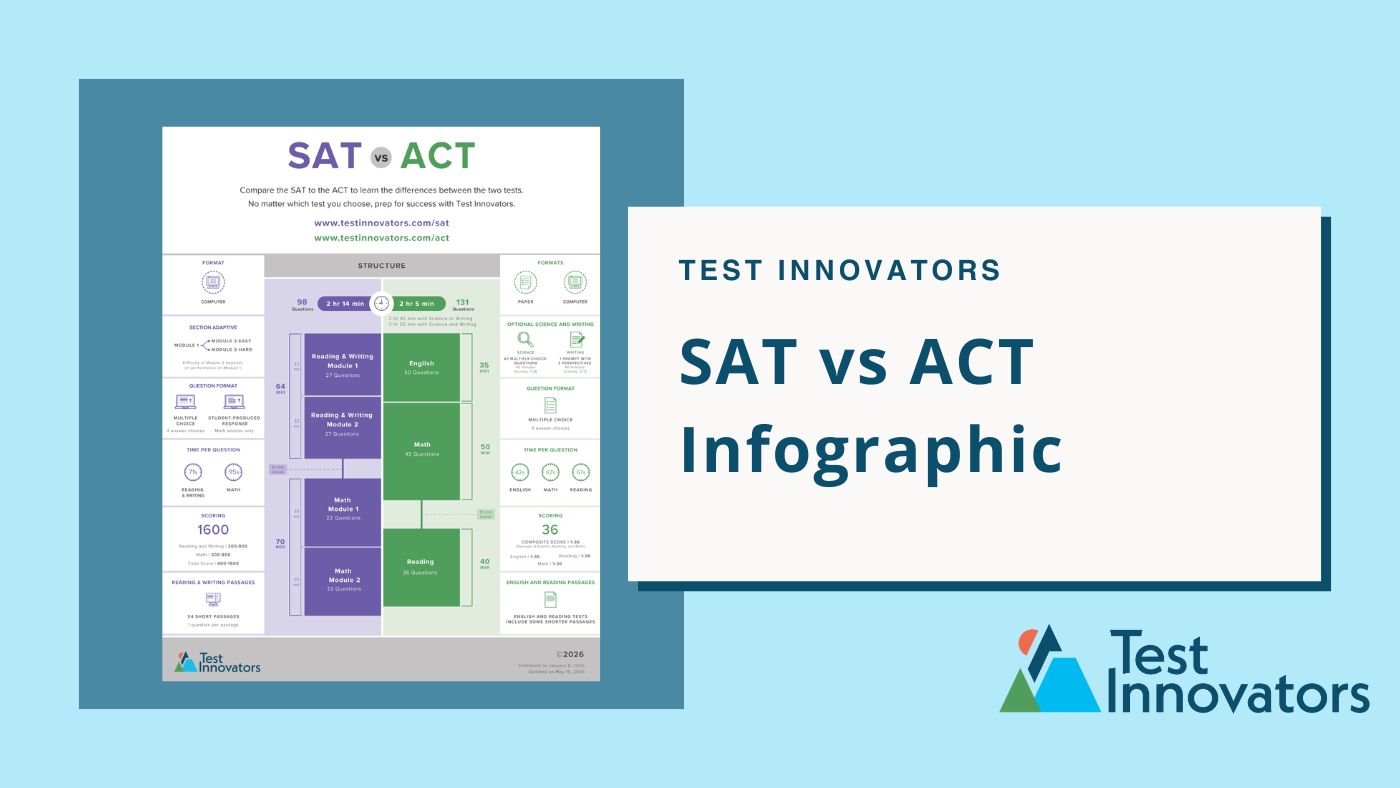
| Section | Time | Questions | Average Time Spent* |
|---|---|---|---|
| English | 45 minutes | 5 passages + 75 questions | 36 seconds/question |
| Mathematics | 60 minutes | 60 questions | 60 seconds/question |
| Reading | 35 minutes | 4 sections + 40 questions | ~180 seconds/question ~35 seconds/question |
| Science | 35 minutes | 6-7 passages + 40 questions | ~90 seconds/passage ~37-40 seconds/question |
| Writing (OPTIONAL) | 40 minutes | 1 prompt | N/A |
*Average time spent is based on dedicating the same amount of time to each passage and question, which will not always be the case. Some passages and questions require more time, while others require less. The average time spent should be used as a guideline, rather than a hard-and-fast rule.
Now, we鈥檒l closely examine each section.
English
The English section consists of 5 passages and 75 multiple-choice questions and tests conventions of standard English, production of writing, and knowledge of language. The questions may refer to an underlined portion of the passage, a section of the passage, or the passage as a whole.
Here are the subjects you can expect on the English section:
- Conventions of Standard English听51-56%
- Punctuation
- Sentence Structure and Formation
- Usage
- Production of Writing听29-32%
- Organization, Unity, and Cohesion
- Topic Development
- Knowledge of Language听13-19%
听
Mathematics
The Mathematics section consists of 60 multiple-choice questions.
Here are the subjects you can expect on the Mathematics section:
- Preparing for Higher Math听57-60%
- Algebra听12-15%
- Functions听12-15%
- Geometry听12-15%
- Statistics and Probability听8-12%
- Number and Quantity听7-10%
- Integrating Essential Skills听40-43%
- Modeling听>25%
听
You are allowed to use a calculator on the Mathematics section. It is important to听know your calculator. When you are practicing for the test, use the calculator you will use on test day. You don鈥檛 want to waste time figuring out how to use your calculator during the test. Also, make sure your calculator has听new batteries. And of course, check if your calculator is permitted. You can review the ACT calculator policy
Reading
The Reading section consists of 4 passages and 40 multiple-choice questions. Start with the passage that鈥檚 easiest for you. The passage types are always the same, so you can predetermine the order in which you complete them and their accompanying questions. It is not uncommon for the Reading section to go unfinished, so you want to make sure you allot time to the questions you are more likely to answer correctly.
Here are the four passage types for the Reading section:
- Literary Narrative or Prose Fiction
- Social Studies
- Humanities
- Natural Science
听
Here鈥檚 an example of a plan for the Reading section:
Let鈥檚 say science is one of your strong suits and social studies is not. Start with the science passage, work through the other passages, and then end with the social studies passage. You might even be able to order all of the passages according to strengths and weaknesses, but at the very least, choose a starting passage and a passage to leave for the end.
Science
The Science section consists of 6-7 passages and 40 multiple-choice questions. The section covers these branches of science: biology, chemistry, Earth/space science, and physics.
Here are three types of passage you can expect to see on the Science section:
- Research summaries听45-55%
- Data representation听30-40%
- Conflicting viewpoints听15-20%
听
Here are the skills that are tested on the Science section:
- Interpretation of Data听45-55%
- Evaluation of Models, Inferences, and Experimental Data听25-35%
- Scientific Investigation听20-30%
听
Writing
The Writing section of the ACT is optional because some colleges and universities require an ACT writing sample and others do not. Find out more about the听ACT Writing section.
Now that you know a bit more about the ACT, it鈥檚 time to start practicing!
Are you an educator? Contact us to chat about how we can work with you.